An AI transformation that cannot name its number is not a transformation. It is a performance — budgeted, staffed, presented quarterly, and unaccountable by design. The fix fits in one sentence: every workflow you hand to AI carries two metrics, a north star it must move and a guardrail it must not. That is the whole discipline. Its absence is why the failure statistics keep arriving on schedule. Its presence is the cheapest thing you can add to a program this quarter.
The wreckage, unlike the programs, is well measured. S&P Global watched the share of companies abandoning most of their AI initiatives before production jump from 17% to 42% in one year. Gartner predicts more than 40% of agentic AI projects will be canceled by the end of 2027. And when MIT's researchers went looking for what separates the programs that produce P&L impact from the ones that stall, their GenAI Divide study reported that the divide is not driven by model quality — it is determined by approach.
Read enough of those postmortems and one pattern keeps surfacing. The failed programs could all say what they were doing. Very few could say what the number was. There was a deck — there is always a deck — and the deck said transformation. The dashboard didn't exist.
Nobody disputes measurement out loud. It gets endorsed in every kickoff and then quietly not done, because measurement has a property the kickoff doesn't advertise: it makes failure visible on a schedule. A program with no number can run for six quarters on narrative momentum. A program with a number has to survive contact with it every week. One of those is more comfortable. The other one is real.
We watch this happen in rooms. Three questions end most of the AI conversations we have with executive teams. Which workflow are we starting with — one workflow, with a name, an owner, and a before-state someone can write down. What number does it move. What number must not move. The rooms that go quiet on all three usually have the largest budgets.
The objections are about the bite
When the room does push back, the pushback is specific, and it is fair. Our codebase is too big for an agent to hold. Our workflows are too complicated. We tried it with Claude and it couldn't pick up our abstractions. And wiring up the integrations is a pain nobody budgeted for.
Every one of those is true — at the scale of the whole org. None of them is an argument against the discipline. They are arguments about the size of the bite.
An agent that cannot hold your monorepo can hold one service. A workflow too complicated to automate end to end has a step inside it that isn't — the intake, the triage, the first-pass review. The abstractions it couldn't learn across forty repos, it can learn inside the one bounded surface you hand it, with your conventions written down the way you'd write them for a new hire — because that is what it is. And the integration pain is real, which is exactly why it belongs inside a bounded budget: priced up front, not discovered in month four.
Notice what just happened, though. Every objection quietly conceded the direction and disputed the dose. That is a different conversation than the one the deck was having — and it is a conversation two numbers can settle.
One workflow, two numbers
The unit of transformation is not the org. It is the workflow.
Pick one. Not "operations," not "the back office" — a workflow specific enough to have an owner and a before-state you can record before anything changes. Then attach the two metrics. The north star is the number the workflow exists to move. It has to exist today, get measured the same way afterward, and be hard to argue with in a quarterly business review. The guardrail is the number that must hold still.
Both come in a small number of families, and knowing the families makes the picking fast. North stars are speed (cycle time, time to first response), unit cost (cost per case, cost per closed ticket), capacity (cases handled per rep, output per head), or revenue (pipeline touched, deals accelerated). Guardrails are quality (error rate, rework), risk (compliance findings, security incidents), customer trust (complaints, churn signals) — and the family nobody instruments: human load. Somewhere inside every successful-looking automation is a person quietly absorbing its edge cases. If no number is watching that person, your north star is being subsidized off the books.
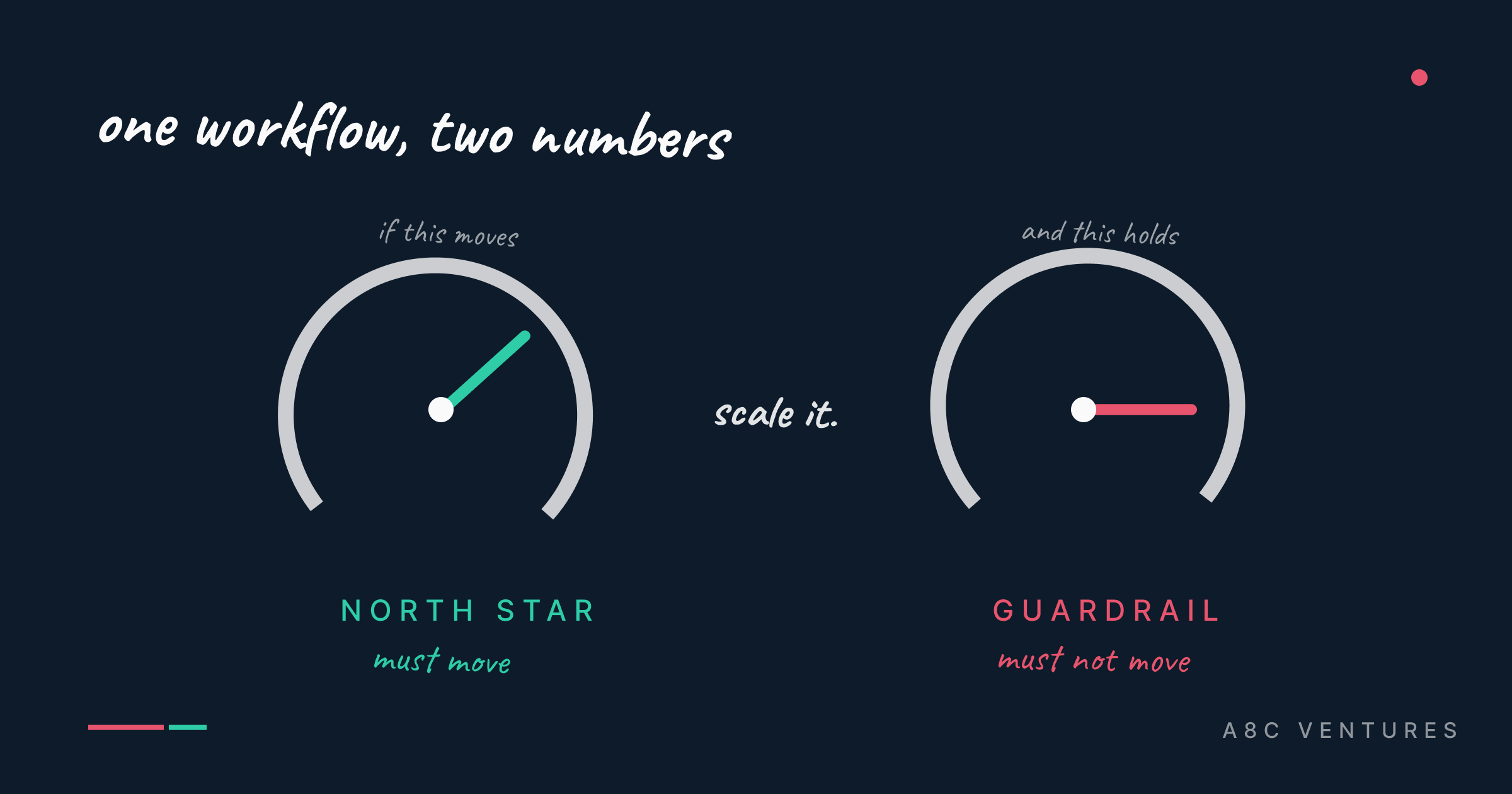
Bound the budget, run it for a quarter, and you have converted a belief into an experiment. The downside is capped by construction — one workflow, one budget, one quarter. If the north star doesn't move, you have bought the cheapest available lesson about your own organization, which is worth more than most consulting engagements. If it moves with the guardrail intact, you now hold a template, and the second deployment costs a fraction of the first.
Sized like that, the bet is asymmetric. Sized like an acquisition and measured like faith, it is just faith with a bigger denominator.
The guardrail can say no
The north star gets all the attention because it is the number that makes the case. The guardrail is the number that can refuse — and it is the one the demo is engineered to hide.
Every AI demo cuts a corner somewhere. Speed is easy to show. What the speed cost — the error absorbed downstream, the edge case routed to a human who wasn't counted, the tone that will generate a complaint in week six — does not appear on the screen. A north star without a guardrail is unpriced risk wearing a favorable chart.
An AI program without a guardrail metric isn't moving fast. It's borrowing against a ledger nobody keeps.
We hold this position because we have been on the wrong side of it. Two of our own agents once ran for two weeks with a permissions gap between them before a review caught it. Every north star we tracked looked fine the entire time. The guardrail metric we should have had — and now have — was the one that would have caught it in a day. The incident became a permanent, enforced gate the same week. That is The Ratchet, and it only works if the guardrail exists to trip it.
Here is where it gets concrete, on our own books rather than in principle.
Scale what proved
We run our firm on an agent operating system — the machine we described in the governance gap — and the measurement discipline is not something we sell before applying. Every agent in the fleet has its own API key, which means spend is a per-agent number we read weekly, not a blended line item we rationalize quarterly. The whole fleet runs on low hundreds of dollars a month, and we know which agent earns its keep. Our first governed workflow was reviewing every change before it ships, with a number attached. The gains from that one workflow paid for the next, and the one after that. Nothing scaled until something proved.
None of this required a platform purchase or a data-science team. It required deciding, before the first dollar, which numbers would be allowed to kill the program. That decision is the entire difference between an operator running an experiment and an executive funding a story — and it is the first question we ask in any advisory engagement, because the answer predicts the outcome better than any technology choice that follows.
The order matters more than the tooling. Money first, metric never — that is the sequence most failed programs ran, and the sequence is the failure. Metric first, money second, scale third is the same money spent in a different order, and it produces a different company.
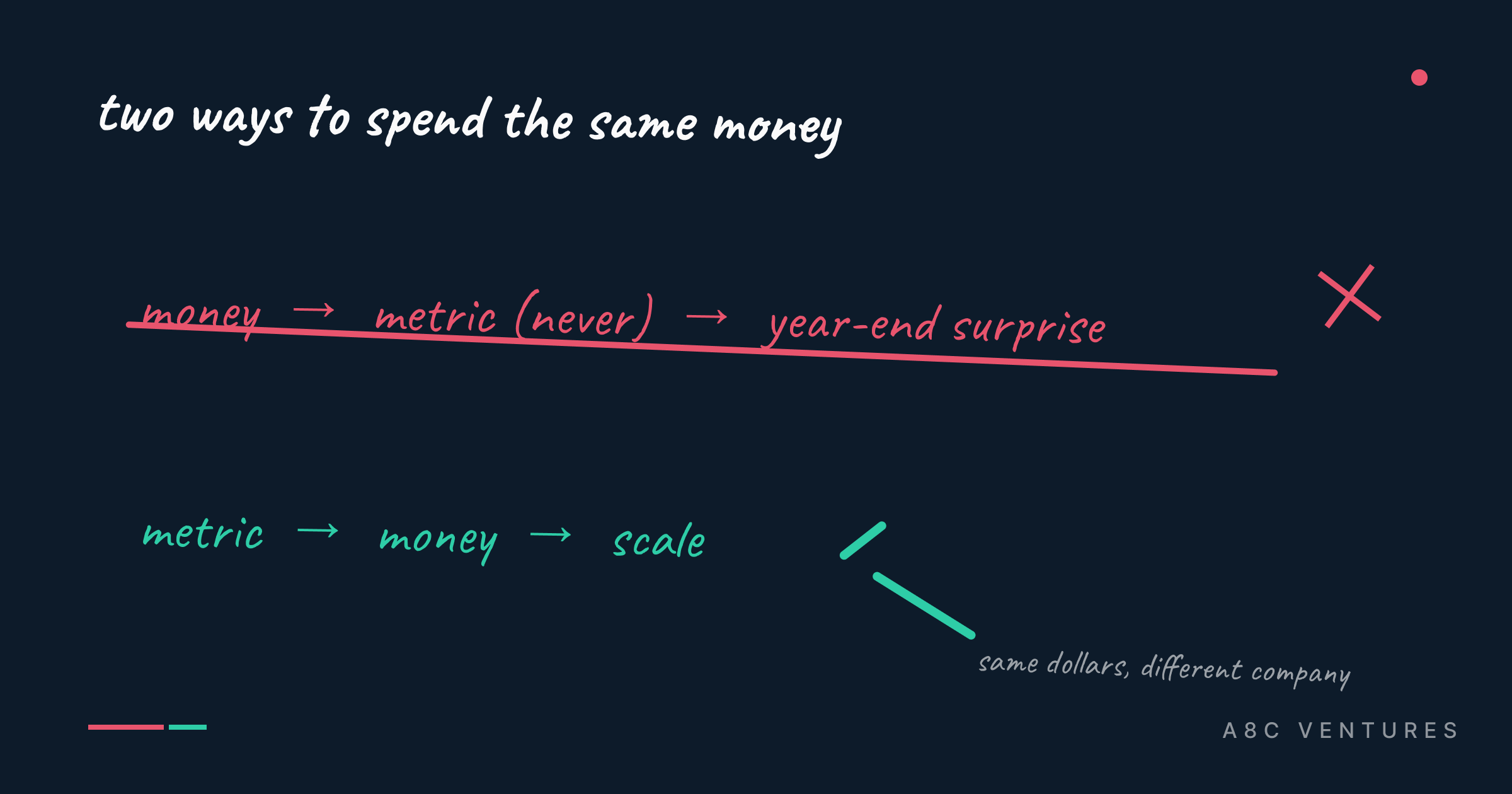
The programs filling the abandonment statistics did not fail for lack of capability. The capability was fine. They failed because at no point did anyone write down the number that would distinguish working from not working, and so nothing was ever allowed to fail — until all of it did, at once, at year-end, in front of the board.
Your AI program will be judged eventually. The only choice you control is whether it is judged by a number you picked in week one or a narrative someone else assembles in week fifty. Story is how you sell the program. Numbers are how you survive it.
A8C Ventures is an AI-native firm building technology for industries where information asymmetry costs people the most.