Getting a model to write your production code is a solved problem. Your team could stand it up this quarter. What should keep you up at night — and what your board will eventually ask about — is whether you can trust what it wrote enough to put it in front of a customer.
The industry keeps score on the wrong number. We benchmark capability, and the capability is real. In November 2025 Claude Opus 4.5 became the first model past 80% on SWE-bench Verified, the field's standard coding test. Anthropic says the large majority of its own new production code is now written by its model. Three-quarters of developers use AI every day. That threshold has been crossed, and it is not un-crossing.
None of it is your advantage. Capability is rented. It reaches your competitor on the same terms, at the same price, on the same release schedule you get. An edge you can buy by the token is not an edge. The thing you can't rent is the machine that decides whether all that capability reaches a customer without taking something down — and almost nobody has built it.
Turn a team loose with agents and the failure mode shows up inside a week. The models write faster than anyone can check. A senior engineer reads a fraction of what a model produces in a day, and the review queue does the only thing it can under that load: it waves things through. Sonar, the code-quality firm, surveyed developers in 2026: ninety-six percent don't fully trust AI-generated code, and only forty-eight percent always review it before it ships. So half the industry is committing code it hasn't read. Sonar's own chief executive, borrowing a term from Wharton researchers, calls that cognitive surrender. Which is generous. It's closer to flying on instruments you've decided not to look at.
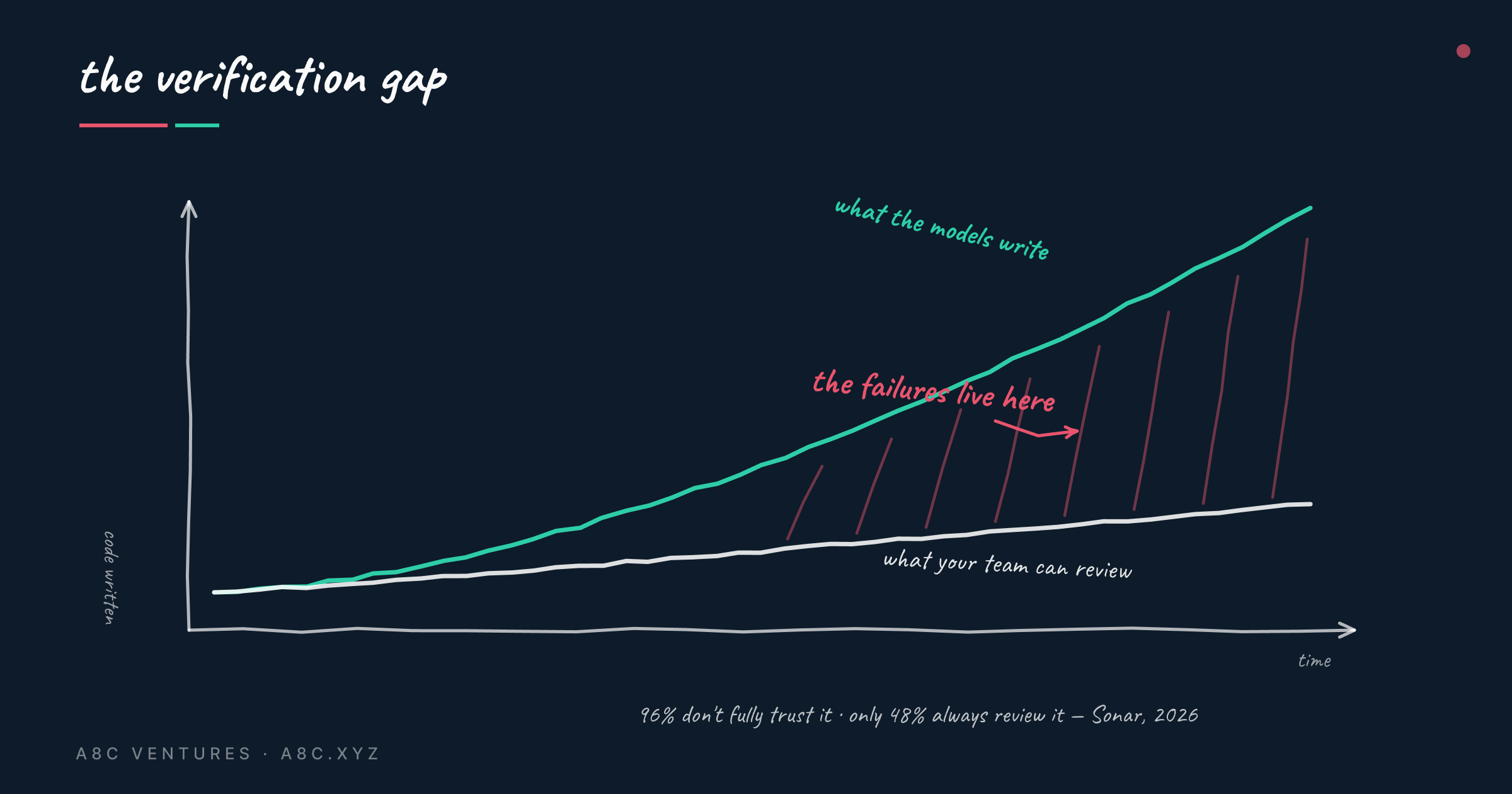
The capability is real. Read the fine print.
Take the numbers seriously, then read the footnotes, because the headlines oversell them. METR — the group behind the chart everyone cites of models handling longer and longer jobs unattended — put a warning on their own work: don't build your plans on it. It measures how long a task takes a human, on coding problems only, and the error bars on the latest figure run from two hours to twenty. On messy, real-world work the models do worse. The scores climbing past the last audited benchmark are self-reported. And the least convenient data point has nothing to do with the model: Google's DORA research, the industry's standard study of software delivery, clocked daily AI use at three-quarters of developers and found that as adoption climbed, delivery got less stable, not more.
So the tools are strong, still improving, and fully capable of making your delivery worse. Sit with that one. If raw capability were the thing standing between you and results, the results would already be on the board.
The gap is a machine you didn't build.
The clearest read on why is in the post-mortems. When MIT looked at why corporate AI programs stall, the conclusion wasn't about model quality. The divide, the researchers wrote, "does not seem to be driven by model quality or regulation" — it tracks with approach: how the work gets integrated, governed, measured. In the same study, tools bought or built with a partner worked far more often than the ones built alone in-house. The stat that traveled from that report — that almost none of the enterprise pilots moved profit — earns its asterisks, a short measurement window and a thin interview base. The finding under it doesn't need them. What kills these programs is not the model.
Every other instrument reads the same. S&P Global Market Intelligence surveyed a thousand enterprises and watched the share abandoning most of their AI initiatives before production jump from seventeen percent to forty-two percent in one year — the average company now scraps nearly half of what it starts between proof of concept and production. That is not a technology statistic. It is burned budget, sitting in a line your CFO can point to. McKinsey finds adoption nearly everywhere and real profit impact almost nowhere — a low single-digit slice of firms. Gartner expects more than forty percent of agentic AI projects to be scrapped by the end of 2027, and the reasons it names are cost, unclear value, and inadequate controls.
Controls. The part nobody funded. No audit trail, so no one can say what the agents did last week. No gate, so a loud enough deadline pushes unreviewed code straight to production. No ceiling on cost or blast radius. And the exposure isn't theoretical. In 2025, security researchers logged formal, CVE-catalogued remote-code-execution holes in the major coding assistants, GitHub Copilot and Cursor among them: a prompt buried in a code comment, a poisoned config file, an issue title crafted to walk off with a privileged token. Ship agent output without a gate in front of it and you haven't shipped a feature. You've shipped an attack surface someone has already published the map to.
The model is rented. The machine around it is the only part your competitor can't put on a credit card.
Say it the way a CFO would accept it. Quality is capability times governance, and you cannot buy your way out of a zero in the second term by running up the first. The firms pulling real value out of this fund review, security, and measurement as engineering — owned, staffed, on the roadmap. Everyone else is generating the abandonment numbers.
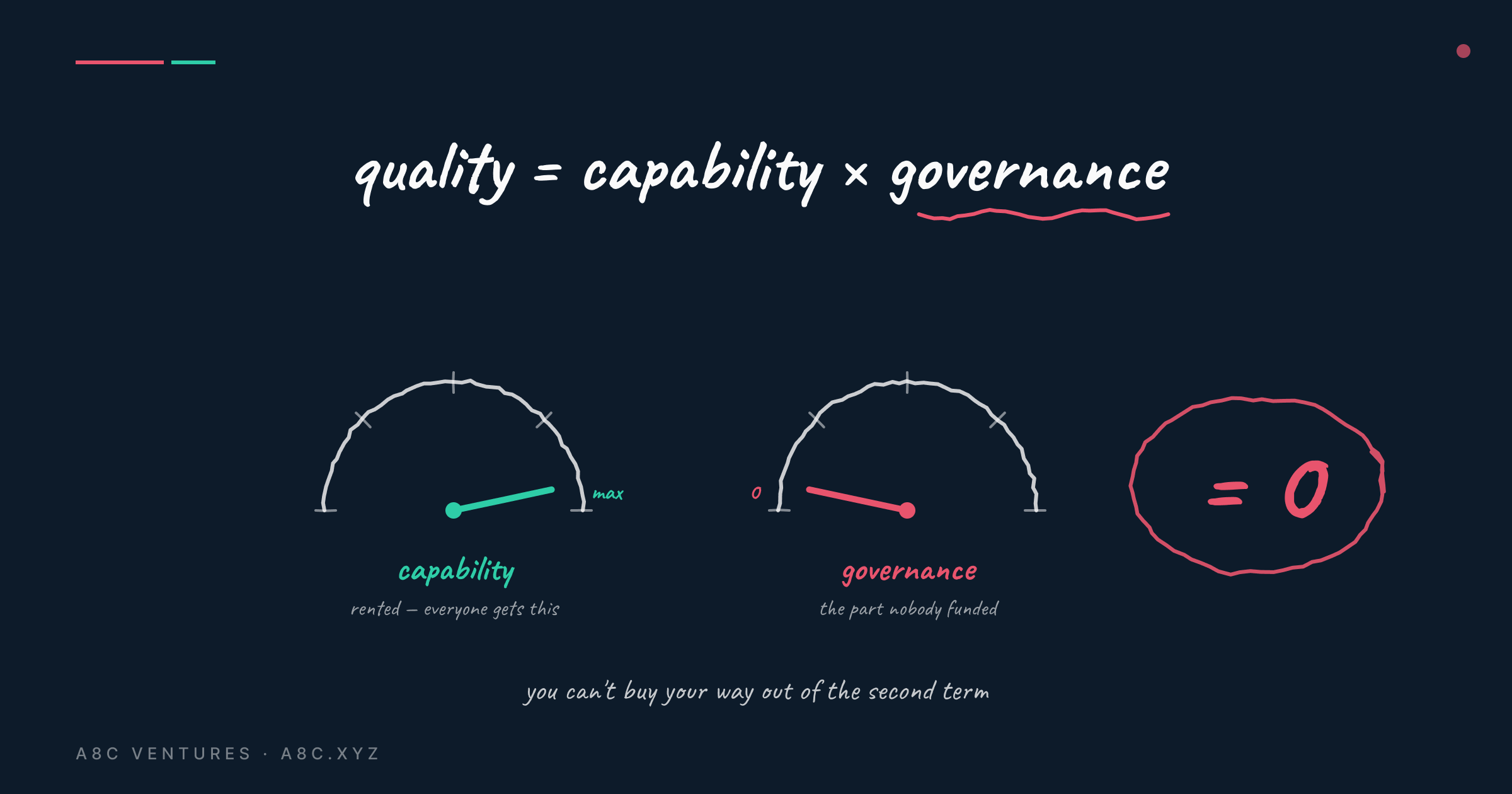
What the machine is.
We run our own firm on one, so this isn't a whiteboard sketch. Under the agents sits a single operating system. A constitution — the rules every agent follows, written once and changed in one place. A reviewer agent that reads every change and holds the line a senior engineer would. Gates for security, tests, and the audit trail that run on every change with no override for a bad week. Nothing an agent produces reaches the outside world on its own say-so. We call the posture Governed Autonomy — agents free to act inside a system that bounds what acting can break.
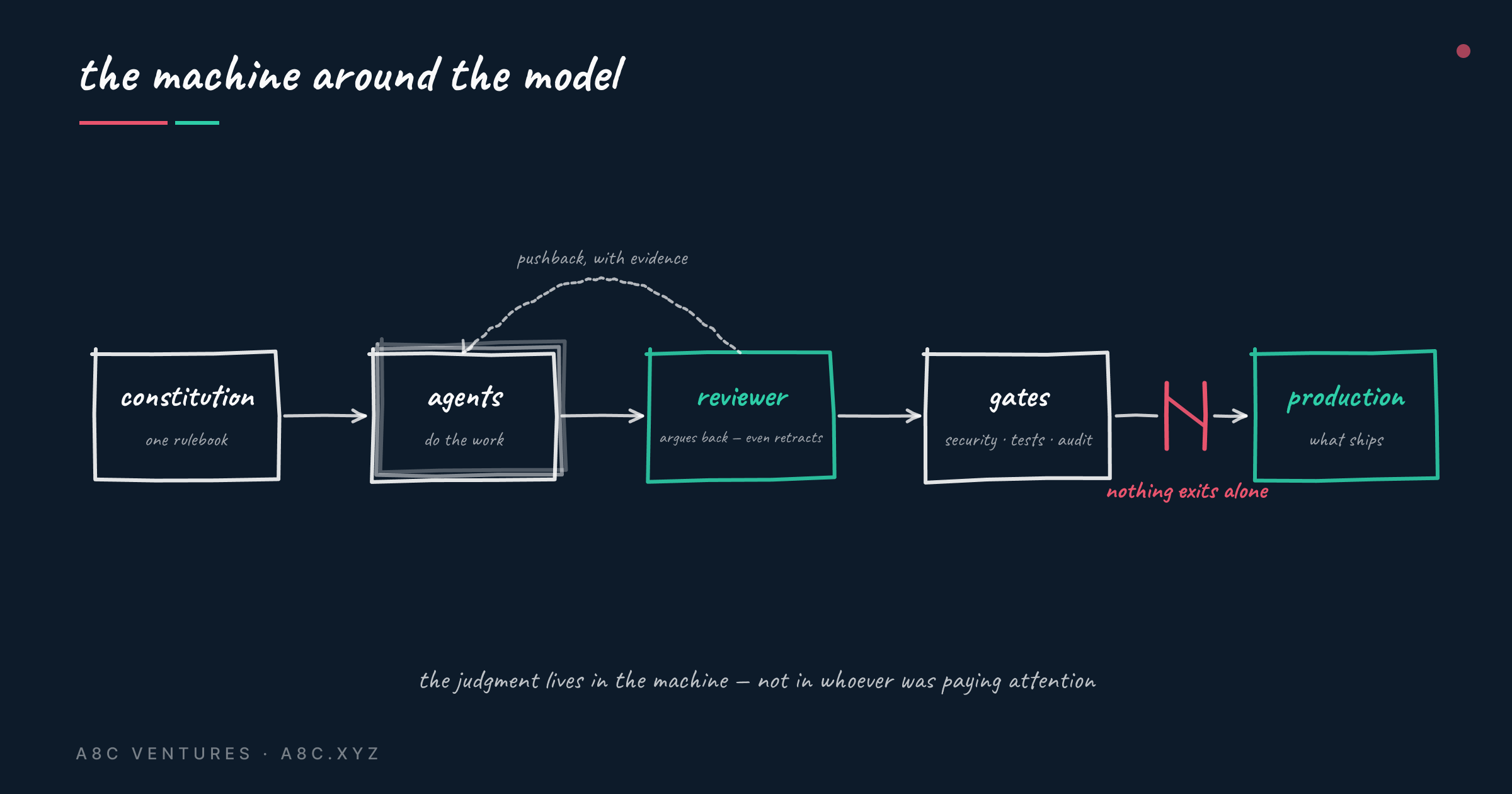
The part that tells you it's real is what the system does when it disagrees with itself. Our reviewer flagged a bug on a pull request. The agent that wrote the code pushed back, with evidence. The reviewer looked again and retracted its own finding — the whole exchange on the record, no human in the loop until the merge. That is an Architecture of Certainty earning the name. Not a model that's always right. A system that can be wrong out loud, settle it, and leave you a trail to read at two in the morning when something is on fire. The judgment lives in the machine, not in whoever happened to be paying attention.
The return is easiest to state as the questions that stop being dangerous. When the board asks what the AI budget actually bought, you point at throughput with the guardrails intact — the profile McKinsey's few-percent high performers share. When an enterprise customer's security team asks how agent-written code gets reviewed before it ships, you hand them the gate and the log, not a policy document. MIT's researchers found a small slice of pilots producing rapid revenue acceleration, and what separated them was not the model — it was approach. The machine is the approach.
None of it needed a smarter model. It needed the unglamorous half nobody demos: the reviewer that argues, the gate that won't move, the log that answers the one question you actually have after an incident. That half is buildable. It's also the only piece of this that will still be worth anything to you next quarter, after the model you're proud of today has been replaced twice.
Capability showed up for everyone at once, billed by the token, improving on someone else's roadmap. Governance is the part still sitting in your budget, unbuilt, and the only part that compounds while you sleep. Bound the blast radius and the upside is yours to keep.
Capped downside. Convex upside.
A8C Ventures is an AI-native firm building technology for industries where information asymmetry costs people the most.