The most under-tooled chief executive in America runs a youth soccer club.
Count the operation the way an operator would. A club fielding teams across a dozen age groups, at a few thousand dollars a player, clears seven figures before the travel economy underneath it is counted. A product measured in recruiting outcomes — teenagers moved, year over year, toward college rosters. Customers drawn from a market American families pour more than $40 billion a year into — more than double the NFL's revenue. Payroll. Facilities. A brand to defend in a crowded regional market.
Now count the tooling: a group chat, a spreadsheet, and memory.
That memory holds the scarcest asset in the market — the map of which events matter, which college programs are actually recruiting, and where a given player stands. The map exists. It lives in heads the families funding everything cannot read. We spent last week watching this market run at full scale, from the stands at youth soccer's national playoffs outside Seattle. What follows is what we saw.
A seven-figure company with no back office
A club director manages rosters across a dozen age groups, negotiates field access, prices a season, runs a coaching staff, and fields the hardest customer-relationship work in any business: parents with money on the table and a child in the product. The recruiting function alone — tracking which college programs need what, brokering introductions, managing timelines that shift with every rule change — would be a salaried role at any company with this revenue.
A dental practice with half the revenue runs on practice-management software, a patient CRM, automated billing, and a compliance stack. The club runs on a group chat. Not because coaches are unserious — because nobody has built for them. The software industry looked at youth sports, saw fragmentation and seasonal budgets, and moved on. The result is a professional-grade operation run on consumer-grade improvisation, and a chief executive whose most valuable institutional knowledge walks out the door the day they change clubs.
That is the supply side. The demand side has it worse.
The sideline nobody could explain
The national playoffs pull families from every corner of the country. Flights, hotels, a week of meals, tournament fees — in a sport whose cost to families rose 69 percent in five years. The whole apparatus stands on one promise: exposure. Play in front of the people who decide.
Here is what we counted from the stands: a handful of college coaches. At the sport's national stage. Parents noticed. Some said so, with an edge — they had paid for the audience, and the audience was thin.
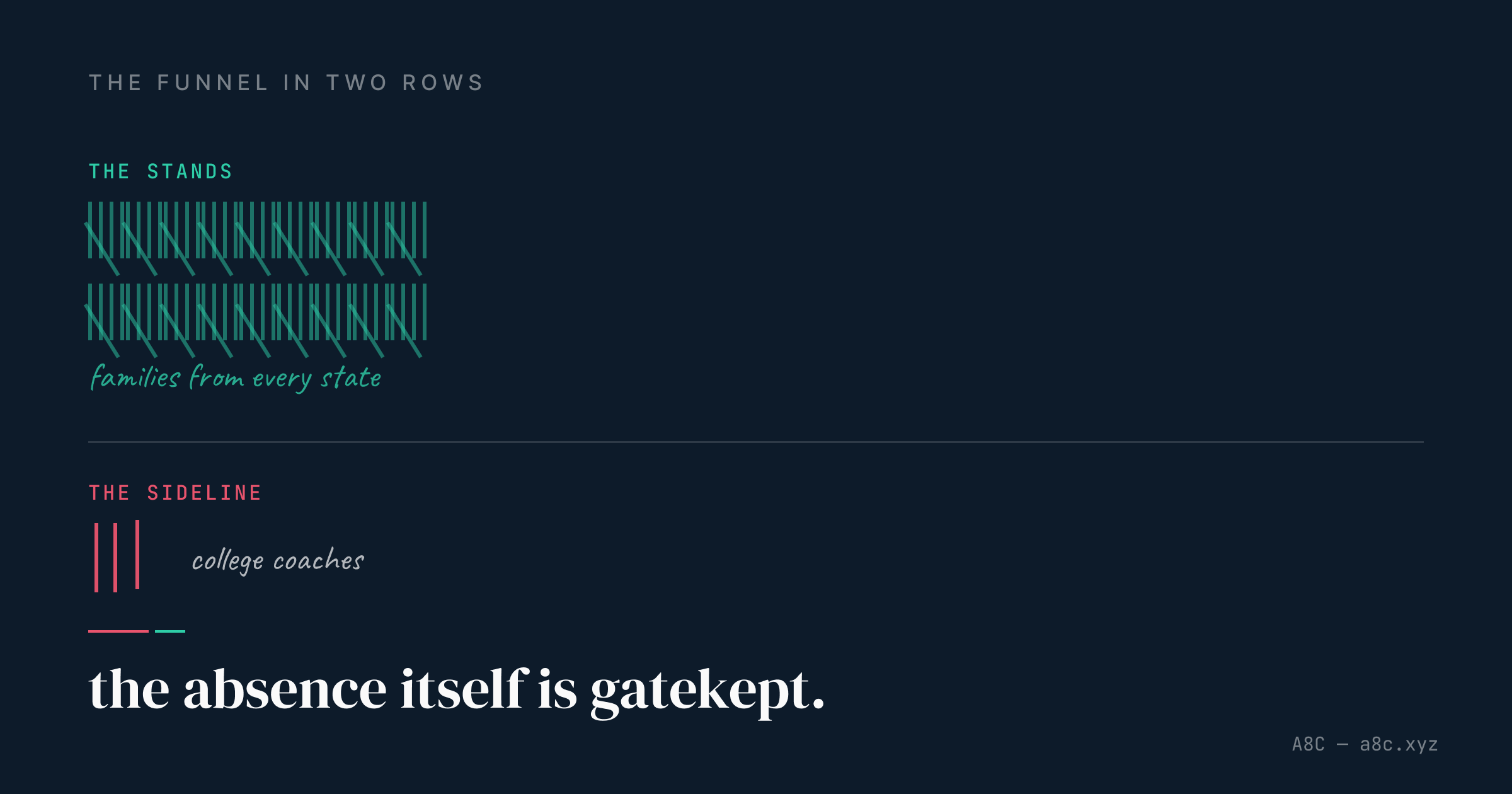
This is our own count, not a census. The scene raises the question; the answer to it rests on public record.
The explanation is not the one you would guess, and that is the point. The NCAA's recruiting calendar left that week fully open — any college coach in the country was free to attend and evaluate. What kept them home is structure. NCAA rules bar coaches from any recruiting communication until June 15 after a player's sophomore year, and most of the age groups on those fields sat entirely below that line: watchable, but untouchable for one to three more years. The oldest class had already played its own finals, weeks earlier, in another city. And the league's own framework points scouts to its older-age events — not the playoffs — advertising "hundreds and thousands" of college scouts on site there.
None of that is hidden. It sits in public documents — a recruiting calendar, a rule book, a league framework. Yet nobody watching could explain the sideline. Not which rule applied, not whether the thin turnout meant anything for their own kid. The families had bought the promise of exposure, flown across the country to collect it, and had no way to know what they were looking at.
The families funding the whole pyramid are the only ones in it without a map.
The scarcity of scouts was not the finding. The finding was that the answer was public — and none of the people paying for the weekend held it. In this market, even the absences are gatekept.
Tools for one side of the table
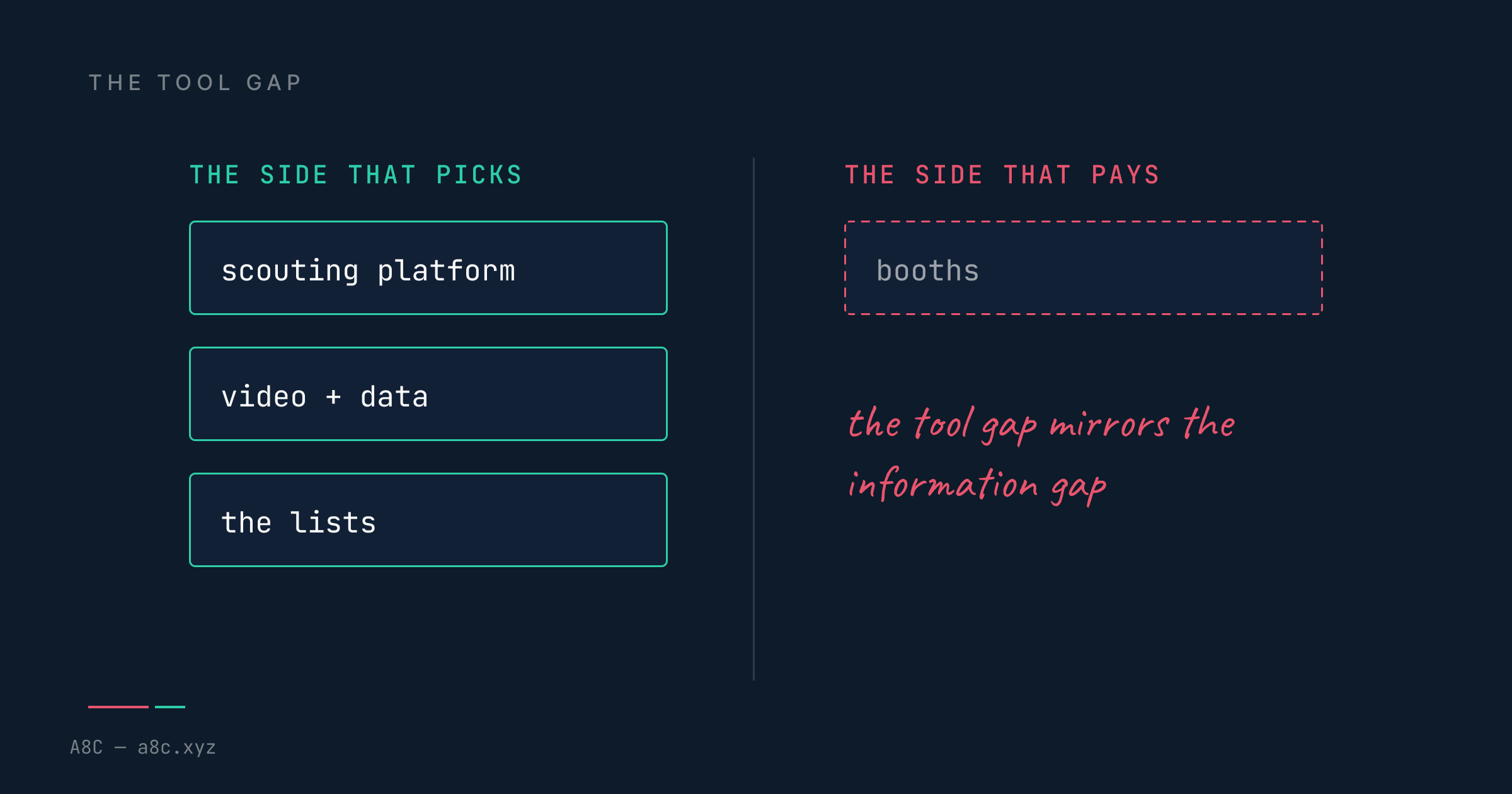
One software company had a booth at the event: a scouting platform, sold to clubs, colleges, and professional scouts — the institutional side of the table. A capable product. Note who it serves. Its customer is an organization; its subject is the athlete, as inventory to be evaluated. The professional instruments in this market all point that direction.
Nothing on that concourse was built for the family as customer. The consumer layer that does exist — recruiting services, rankings, highlight-reel packages — drew little interest, and the ambivalence looked earned. The largest recruiting service in the country does not publish its prices: five tiers and a schedule-a-call button. Families report paying four figures. A market that prices its own product behind a phone call is telling you what it sells — and it is not clarity.
The tool asymmetry mirrors the information asymmetry exactly. The side that already holds the map gets software. The side paying for everything gets booths.
Building for the side that writes the checks
Markets like this are why our firm exists. The gap between what the institutional side knows and what a family can act on is not a niche inconvenience — it compounds across every one of the families in that $40 billion, in decisions about real money and a child's ambitions. And it is closable. The recruiting calendar is public. The odds are public — about eight percent of high-school players reach any NCAA roster, fewer than three percent the top division. Where a player stands, which events matter, when the window actually opens: answerable questions. They just are not answered for the people who need them.
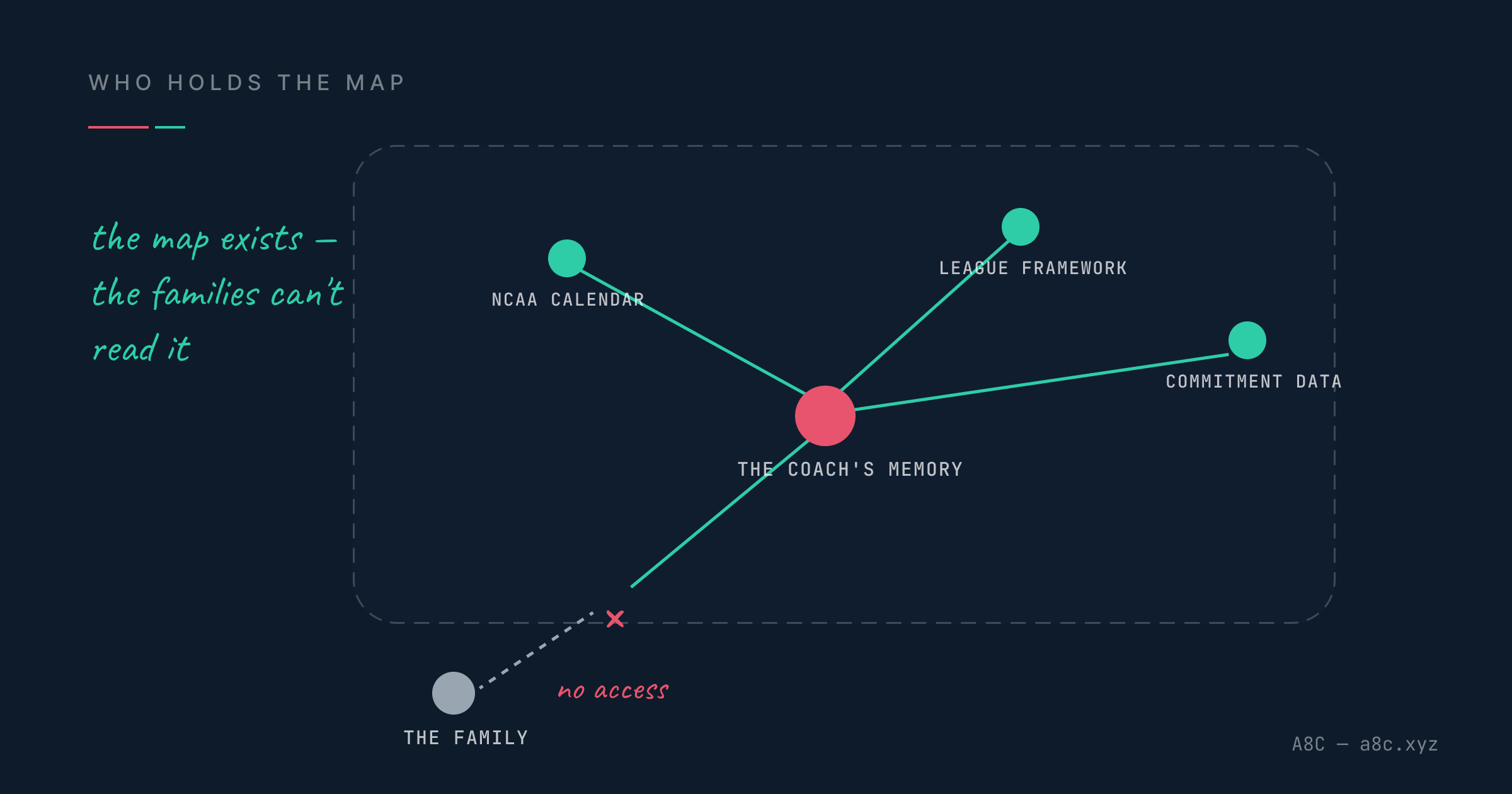
Closing that takes Embedded Judgment — the exposure map compiled into the product itself, so a family's decisions stop depending on which club coach's memory they happen to rent. That is the standard we hold in the college-recruiting market we've been building in, and the test we would put to anyone building in a vertical: does the product move the information to the person writing the checks, or does it charge them again for the gap.
The club coach was never the villain here — just the most under-tooled CEO in America, holding the market's map in their head because nothing else will hold it. Build the coach a back office and you have built a better club. Build the families a map and you have changed what the market is.
A seven-figure operation on a group chat is not a quirk of youth sports. It is what a market looks like the day before somebody builds for it.
A8C Ventures is an AI-native firm building technology for industries where information asymmetry costs people the most.